Could a Universal Military Draft Prevent Wars?
If everyone had to serve, could that make cowboy attacks like Trump's less likely?

**
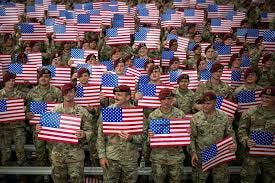
(Editor’s Note: Last week I wrote a Substack post arguing that if we had a fair and equitable military draft, it might make it harder for presidents to start and wage “forever wars” like Bush’s in Iraq or the one Donald Trump just started in Iran. Here’s an updated version of that argument; a version of this column ran in the Toledo Blade newspaper today. JL )
**
LANSING, MI – When it became clear that President Trump was launching what looked like a major military operation against Iran, and the first American deaths were confirmed, my mind flashed back more than half a century, to the days of the military draft.
This was in 1972, when the Selective Service system was switching to a lottery system. They were drawing dates and assigning them numbers. If your number was 80 or less, you were all but certain to be called up; if it was over 200, you were safe.
At least that’s what they were saying. Eventually, there were only five dates left. As I remember, young men who were unlucky enough to be born on four of those days might as well head down to an induction center. But the last number was a totally safe 294, and somehow, that, by the luck of the draw, was the number given to me.
That was the only lottery I ever won in my life, and I couldn’t have been happier or more relieved. In less than a year, Washington announced a peace treaty that ended our participation in the Vietnam war, and almost simultaneously, President Richard Nixon succeeded in abandoning the draft and adopting instead an all-volunteer army.
Young men are still legally required to register for Selective Service, but none have been drafted since.
I was thrilled. This meant, or so I thought, that no American who didn’t want to go to war would ever have to fight, or waste years of their lives in military service again. I also naively thought it would make it harder for presidents to send troops into combat.
Well, I was clearly wrong about the latter. Though we’ve never been involved in a war on the scale of Vietnam since conscription ended, time and again, presidents have sent soldiers to places from Grenada to Lebanon to Africa.
There has been little protest. Gradually, I became aware that this was partly because the end of conscription meant not only a volunteer army, but the replacement of a compulsory draft with an economic one. Years ago, a professor I knew called today’s military the “poor man’s IBM,” meaning that it was the one place young men without means or connections could go to get secure employment.
Except, of course, that the job meant you might have to kill people and/or be killed. Back in the late 1990s, I advised a few of my college students to consider joining up. These were young men who were drifting, didn’t know what they wanted to do and came from troubled homes.
I reasoned that President Clinton was unlikely to invade someplace for kicks, and the volunteers would get exercise, learn discipline and come out with money for school.
A couple of them took my advice. But I stopped doing that after the September 11 attacks, when it became clear we were in for war. We ended up fighting in Iraq and Afghanistan far longer than we did in World War II, and as far as I can determine, only four congressmen and one senator had kids who served in those conflicts.
During World War II, dozens of congressmen had sons in combat, some left Washington and fought themselves, and President Franklin D. Roosevelt alone had four sons in the war.
During World War II, evading the draft was seen as an extremely shameful thing. More than 400,000 Michigan men were drafted. Many, of course, didn’t want to go, but they did, and we were ashamed that the only soldier executed for desertion during the war was Eddie Slovik, a private from Detroit.
But by the time I was waiting to see if I was going to be drafted, evading the Vietnam-era draft was almost a sport. Presidents George W. Bush, Bill Clinton and Donald Trump all did so in various legal ways. Thousands of others fled the country.
For years I thought this was because World War II was so different in that we had been attacked by our enemies, and the nation was instantly united as a result. But William Manchester, in his magnificent history The Glory and the Dream, pointed out another difference. In World War II, the sons of presidents and plutocrats were also liable to be drafted too, if they didn’t volunteer.
When they were, they went, and some indeed died.
Today we have a military which is far more Black, Hispanic and poor than the population as a whole.
And I have to wonder if the children of the Ford or DeVos families, or those of Bill Gates or Jeff Bezos had to serve, whether presidents would be as likely to start even limited wars.
I have argued this for years; if everyone is subject to conscription it might make the policymakers more cautious about starting wars of choice. It also would mean more Americans with skin in the game, which would likely make stupid wars like the current one even less popular than they already are.
I believe the Selective Service should be extended to register EVERY American at age 18, regardless of gender. In the past tapping only males was a way to require young males to defer to older males and to *restrict* females on the assumption they were just baby makers. (*Restrict in the sense that poorer females had less little access to the higher education, travel, and professional careers the military offered.)
I also would love to see Selective Service expanded into National Service, which could be the military but could also be directed toward more humanitarian agencies as well as weather recovery teams such as wildfire fighters and FEMA. The whole concept needs to be revised.