Hamtramck's Memory Has a Name, and a Place
Greg Kowalski has devoted his life to the fascinating town where he was born

(Editor’s Note: Last week I published a Substack column about an amazing man who has devoted his whole life to the little city of Hamtramck. This somewhat fuller version appeared in the Toledo Blade newspaper today. JL)
**
HAMTRAMCK, MI – For years, Hamtramck, a tiny enclave city embedded in Detroit, was a symbol of Poland in America. More Polish than English was spoken on the streets and in the shops.
On Fat Tuesday, people would flock to Hamtramck to walk down bustling Joseph Campau, the city’s main drag, and buy the rich jelly donuts known as paczki (poonch-key), eat the dumplings known as pierogis, and later pretend to diet.
The high point of many Hamtramck lives came on Sept. 18, 1987, when Pope John Paul II, the former Karol Wojtyla, born in Poland, came to that town of two square miles to visit.
Greg Kowalski, who was born in Hamtramck in 1950, was there that day. In fact, he’s been there three-quarters of a century, devoting himself to his city in a way that may be unmatched. He has written no fewer than 11 books about it. Take him driving around Hamtramck, with its century-old frame houses and postage stamp lawns, and he knows virtually everything about every building.
Hamtramck has radically changed from the city the Pope saw. The Polish-Americans are less than five percent of the 28,000 people who live in the city today. Instead, Hamtramck has become mainly Muslim, Yemenis, Bangladeshis and Bosnians. The mayor and city council are all Muslim, and the call to prayer rings out five times a day.
But Kowalski is still as devoted to Hamtramck. “I’ve never wanted to live anywhere else,” he told me years ago. “When I die, I want my ashes scattered on the railroad tracks so I can always be here.” He is both a historian and a journalist, who had a fine career, much of it as editor of the twice-weekly Birmingham Eccentric, a paper in a highly affluent, WASPish town as different from Hamtramck as two Detroit suburbs could be.
But for years, he’s had a dream: To build a first-class museum displaying the entire history of the fascinating little world of Hamtramck. Somehow, defying the experts, he made it happen.
Welcome to the Hamtramck Historical Museum, which occupies a large building in the city’s center, in what was once a barber college. Today it is filled with fascinating and sometimes zany artifacts with captions which range from poignant to hilarious.
A sign in the bathroom informed me that a century ago, I would be trying to take care of business outside, which, it unnecessarily advised me, would not have been fun in January. Photos show JFK campaigning with then-governor Soapy Williams in Hamtown (one of the city’s many nicknames.) There are pictures of 1920s gangsters, some of whom went to jail; and of Hamtramck’s mayors over the years, some of whom didn’t.
All of this started when the city created a Hamtramck Historical Commission in 1998, and named Greg to chair it. They didn’t have an artifact, a historic record or a building, but they started planning and collecting. A few years later another nonprofit group, the Friends of Historical Hamtramck was formed, got possession of the deserted barber college and gave it to the historical commission.
They renovated, cleaned and redesigned. At first, some feared that Mr. Kowalski and his band of volunteers would make it essentially a history of Polish Hamtramck.
Not so. “We want to make this a living museum that reflects all the different ethnic groups who have come here,” he told me.
Indeed, one of the city’s defining slogans has been “the world in two square miles.” Accordingly, they hired Dennis Orlowski, a famed local artist, to paint a series of murals to wrap around the inside walls of the museum, honoring the legacy of all the different groups who lived and still live in Hamtramck, from Native Americans to Jews.
The Hamtramck museum has won grants, partnered with a university on archeological digs, and also become a thriving community center.
It hosts lectures, author talks, and held two “Roaring Twenties” speakeasy parties, in which patrons dressed up like characters from the era, and donated money to help the museum.
The last year or so has been tough for Kowalski, who has been battling cancer and the effects of a serious fall. “The worst part is not being able to come in to the museum every day,” he told me.
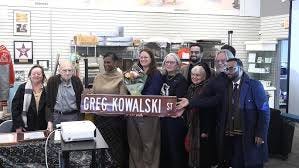
But he was there on January 18, when citizens, politicians and state and community leaders came for a special event.
They were there to honor him, and to tell him that the city council had renamed Wyandotte Street Greg Kowalski Street. The usually unflappable old journalist was overcome with emotion, saying. “I can tell you that my mother and father are dancing in heaven.”
Max Gilginas, Hamtramck’s community improvement coordinator, said that Greg “didn’t just study the city’s history. He helped preserve it for future generations.”
As diverse as its residents are, on this they agree:
Nobody wants to see ashes on those railroad tracks, anytime soon.
-30-

You’ve convinced me I need to go.
Fantastic profile of someone truely dedicated to preserving local history. What stands out is how Kowalski made teh museum inclusive of all Hamtramck's waves of immigration rather than just a nostalgia project for Polish heritage. I grew up around communities like this and seeing leadership that adapts to demographic change while honoring roots is pretty rare tbh.