Remembering Dr. Death on Memorial Day
He was, after all, a veteran, who sincerely wanted to stop suffering

There’s a grave of a war veteran in White Chapel cemetery that’s unlikely to get any flowers or visits from American Legion types today. It’s the grave of Dr. Jack Kevorkian, and this just happens to be his 97th birthday.
Kevorkian, who died in 2011, is remembered, of course, as the apostle of physician-assisted suicide for not only just the terminally ill, but those who were suffering from pain that couldn’t be alleviated. Prosecutors, fanatic Christians, and much of the media saw him as a mentally ill menace to all that was holy.
I saw him as a crusader, if an extremely oddball one, and a genuine hero. I knew him very well for a few years, though we later had a falling out and he stopped speaking with me after I criticized some of his self-destructive behavior. But he did a world of good, far more than he ever knew. Doctors, many of whom were a callous lot, have gotten much better and much more serious about pain management.
The hospice movement has really taken off, as an alternative between needless suffering and suicide, and, perhaps most importantly, 10 states have legalized or at least decriminalized assisted suicide in some cases. Too often, they only permit it for those who live in their states and have less than six months to live.
That’s not broad enough. Nobody wants a 19-year-old who has been dumped by his girlfriend or a 20-year-old who got turned down for her dream job as a flight attendant to be able to get legal help to kill themselves.
I have a very happy life and want to live as long as I can reasonably function. But if I am diagnosed with Lou Gehrig’s disease, I am not waiting to strangle on my own spit, and if I get early onset dementia (keep quiet if you think I have it already) I’m not going to wait till my sweetheart finds me playing with my feces.
This is officially a secular country, whatever the Moron Mussolini may say, and for too long, fundamentalists have been allowed to impose their morals in such matters on others; adults should have the right to self-determination here too.
Kevorkian, who politically was somewhere between an anarchist and a unitarian, understood that. He could be charming when he wanted to, though much of the time he was a rude and cranky boor. But that doesn’t matter.
He made us ask the question essential to civilization: Does it really have to be this way? That alone should qualify him for the Presidential Medal of Freedom, if not the Nobel Prize.
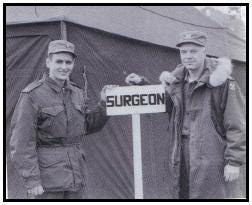
(Editor’ s Note: The photo above shows Kevorkian, left, at an aid station in Korea c. 1953, after the intense fighting had essentially stopped. This is believed to be the only time the future pathologist treated living patients. )
spot on. he was multifaceted . His cause made me write up the assisted morphine deaths that occurred when compassionate doctors ordered self infusions of morphine. Also i see the faces of patients that begged me to help them die. THANKS for the moment on memorial day bev
He was a hero to me too, even tho he scared my kids who thought I was on his list of ms patients. I loved the weirdo!