The Truth About Labor Day
Remember the middle class? Unions are why there was one

The other day, when I realized that Labor Day was just around the corner, I remember a story I had read long ago about President Franklin Roosevelt’s funeral in April, 1945. David Lilienthal, then the head of the Tennessee Valley Authority, asked the man who drove him to the airport what he thought about FDR.
That long-dead driver told him “I won’t forget what he did for me. I spent the best years of my life at the Appalachian Mills and they didn’t even treat us like humans. If you didn’t do like they said, they always told us there was someone else to take your job. I had my mother and my sister to take care of. Sixteen cents an hour is what we got. You can’t live on that. If you asked to get off on a Sunday, the foreman would say, when you come back Monday, someone else will have your job.
“President Roosevelt made it so they couldn’t do that to us any more.” Well, the driver was right up to a point, but the main thing FDR did was to empower and free the unions to organize workers and collectively bargain.
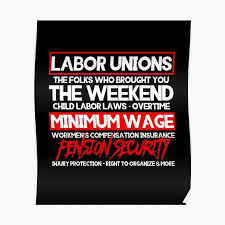
That made a tremendous difference in the lives of millions. Ten or so years ago, I was in Marquette, of all places, late one summer, when I saw a bumper sticker that said “Unions. The People That Gave You the Weekend.”
It could easily have said, “The People Who Gave You the Middle Class,” since both are true. But in recent years, unions have lost membership, and respect. Sixty-five years ago, John F. Kennedy came to Detroit on Labor Day to kick off his campaign by appealing to labor and the working class. It was a smart strategy. Union members overwhelmingly voted for him, and union leaders got off the vote.
Kennedy won a narrow victory in Michigan and nationally, and when the TV networks awarded him the state the next morning, that’s when the Secret Service concluded that he had won and swooped in to protect him. Back then, 32 percent of private sector employees were unionized.
Today, only a tiny, 5.9 percent of private sector workers belong to labor unions. Nearly one third of public sector (government ) workers are in unions, but many have limited bargaining power. By the way, it isn’t true that most union members voted for Donald Trump. Respected surveys showed that Joe Biden, who former Teamsters President James Hoffa calls the best president for labor in modern history, got 56 percent of union votes, and Kamala Harris slightly bettered that, beating Trump 57-41.
But working class voters who aren’t in unions voted for Trump. Democrats stopped paying much attention to working class voters some time ago. In many ways, how people vote is almost a mirror image reversal of the Kennedy era. Harris won a majority of voters with a college education; Trump won those who didn’t have a four year degree. Households with incomes over $100,000 a year voted for Harris; the less well off voted for Trump.
However, what hasn’t changed is that by and large, workers represented by unions do better financially and have more job and health care security than those who aren’t. Yes, unions can be inefficient, bureaucratic, and their leaders are occasionally corrupt.
But they are still essential, and that’s a message they, and the politicians who want their votes need to be hearing on Labor Day, and every day. And union leaders need to be educating their members and other workers about how bad Trump and his policies are for them, and calling out his lies.
Too many workers have already lost their weekends, after all, and a lot more besides. So happy Labor Day. Just stop to remember what it really means.