Why I Write
Writers' motivations for writing differ, but are also the same

Someone asked me recently why I write here, especially every day.
I was tempted to say, “because the money is so good,” which is the smart-ass answer the brilliant and doomed topical folksinger Phil Ochs used to give when he was asked why he wrote and sang protest songs. He didn’t mean it either.
Part of the reason is that I know a fair amount about how things work politically, and have a fairly vast store of literary and historical knowledge, which is another way of saying I am old, and have done this a long time, and have seen and experienced and learned many things that it seems right to me to share.
I am a teacher at heart, and feel motivated to share information and shed light on things that are, or should be of interest to a lot of people. We are living in a time of great upheaval and uncertainty, political, intellectual and otherwise. We all can and do get carloads, or I should say, gigabytes of information, but clearly accurate information is not always easy to come by, and I feel I can sometimes help sort things out.
This is not the only writing I do. I have a couple of other, long form writing projects — books — I’m working on, but doing an essay every day is good discipline and mental exercise, and nearly all of us appreciate something short and concise.
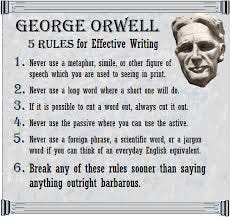
The truth is that I write for a number of reasons, one of which is that I simply don’t have any talents that anyone would pay me for other than writing and perhaps speaking. But I am also driven to do it. George Orwell, my journalistic hero, once said that while writers to some extent have different motivations, he felt that we are all driven to write by a demon, and “for all one knows, that demon is the same instinct that makes a baby squall for attention.”
By the way, whenever someone tells me they are trying to figure out whether they were meant to be a writer, I always tell them to read Orwell’s wonderful short essay, “Why I Write,” after which you will know the answer. Oh, you may well be in denial about it; both I and Orwell himself tried to avoid it for years.
But you’ll know, all right.
Don’t think I am putting myself in the same class as Orwell. Nor do I love or agree with everything he wrote, and I think I’ve read about everything he did write.
But I think of him often, just to keep myself honest. One of literature and journalism’s saddest realities is that Orwell died of tuberculosis in 1950 when he was only 46. If I’d fathered children, they might be around that age now, which strikes me as incredible. It certainly isn’t fair that I’ve been given so many more years, but all I can do is use them as best I can.
You can easily find Why I Write for free online, and read it in less than half an hour. But don’t just read it once. I’ll close with two of the most important things he says about writing: First, avoid getting stuck in a perverse mood.
And most importantly for journalists : “Good prose is like a window pane. One can write nothing readable unless one constantly struggles to efface one’s personality.”
That may sound like a contradiction, but it’s not. Here’s to my writing continuing to be useful; enlightening and enjoyable to some, and coherent to all.
See you tomorrow with an essay that hopefully makes at least some people say, “Wow. I didn’t know that.”
Now we know why you write. I'm among readers who may await another post about picking George Orwell as your literary hero. Maybe it's not entirely the familiar George Orwell of "1984" and "Animal Farm." Maybe Orwell's OTHER fiction and non-fiction? These are lost treasures worthy of hero worship status. "Burmese Days," "Down and Out in Paris," "The Road to Wigan Pier," and more. Here's your hed: "Why George Orwell?" We await the -30-.
Beautiful, Jack. I’m going to look up Orwell’s essay - it’s a question that comes up regularly. Thanks for writing!