Question Time
... so just why do we need the electoral college, anyway?

I’ve written about politics and history for so long that I’m startled sometimes when I learn that many people are still puzzled by things like the Electoral College.
But then I realize that it is confusing, and that people can’t be blamed for not understanding it, because its existence appears to make no sense. How could Hillary Clinton get nearly three million more votes that Donald Trump and be ruled the loser?
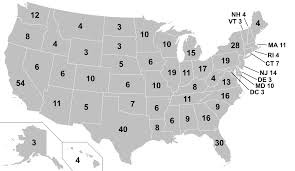
The other day, my faithful reader Laura wrote “You know, I’ve never understood why we need the Electoral College as well as the popular vote in any election. Whichever candidate gets the most votes wins, right?”
Well, yes, and no. Most electoral votes, yes. Most popular votes, maybe. Most of the time, actually — but not always.
I will explain in a moment. But first, here’s how the whole thing started. The founding fathers were brilliant political philosophers. But they overlooked one big thing. They didn’t foresee political parties. Their idea was that the best and smartest people in each state would get together in their state capitals and come up with the best possible choices for president and vice president.
Actually, they thought that in most elections nobody would wind up with a majority, and then the House of Representatives would pick the president, which happened in 1800 and 1824. George Washington was picked twice, unanimously, by the members of the Electoral College. But by the time he left, two major political parties had formed: The Federalists, ancestors, more or less, of today’s Republicans, and the Republicans, ancestors of today’s Democrats.
Soon, the states started letting people vote for slates of electors pledged to a candidate, and before long, this evolved into a system where people were voting, or thought they were voting, for presidential candidates, though they were really voting for slates of electors. The number of electors each state has is two — plus the number of congressmen or congresswoman from that state. (The District of Columbia, which was first allowed to vote in 1964, the only non-state with electors, has three.)
All together there are 538 electors, and to win an election, a candidate has to have 270, one more than half. Back in April, 2000, I was solidly in favor of keeping the Electoral College. It hadn’t failed to elect with the winner of the popular vote since 1888, and most of the time, it magnified the winner’s share. Ronald Reagan won 59 percent of the popular vote in 1984, but more than 97 percent of the electoral vote. Bill Clinton got 49 percent of the popular vote in 1996 to Bob Dole’s 40 percent, but 70 percent of the electoral vote.
But then, in 2000, it misfired. The popular vote was very close — Al Gore won it by less than one-half of one percent — but George W. Bush won 271 votes to Gore’s 267 in the Electoral College. That was the first time most Americans had paid any attention to electoral votes in a century.
That result didn’t change by opinion much; I thought Gore was probably the real winner anyway, and was cheated out of the presidency because of defects in Florida’s election machinery. But the misfire was much worse in 2016. Hillary Clinton won the popular vote by 2,868,691, but lost in the electoral college, 304 to 227.
Actually, it should have been 306 to 232, but five Clinton and two Trump electors violated the voters’ trust and voted for other candidates — another potential problem,
So, should we abolish the electoral college?
Maybe not. If the election was decided by the popular vote only, after the primaries, no voter outside a few huge metropolitan areas would ever see a candidate after the primaries. And what if the election were terrifically close?
If you look up the 1960 election, you’ll find that John F. Kennedy beat Richard M. Nixon, 34,220,984 to 34,108,157. But the Kennedy figure is an invention. In Alabama, voters that year could pick some Kennedy electors and some unpledged ones.
The figure above is an average of all the Kennedy electors. If you use the numbers for the lowest Kennedy elector, Nixon was the winner of the popular vote.
Can you imagine a nationwide recount? I can’t. Tomorrow, I’ll suggest some ways to improve the system you may not have thought about.
Simply stated, the Founders wanted to avoid direct election of the president. State's rights were still a left over attitude controlling public policy. Remember that power and the right to vote was still with land owners and only half the population (women) could not vote. Some fear of the mob was a factor for the framers of public policy. Perhaps fear of illiterate and ignorant voters also existed. Ironic eh?
Thank you Jack. The electoral college can be a bit confusing. And another trend by the far right is to cancel the 19th Amendment giving women the right to vote. We cannot let this happen and will need as many men as women to fight this nonsensical movement.